World Social Work Day at the United Nations Office Geneva
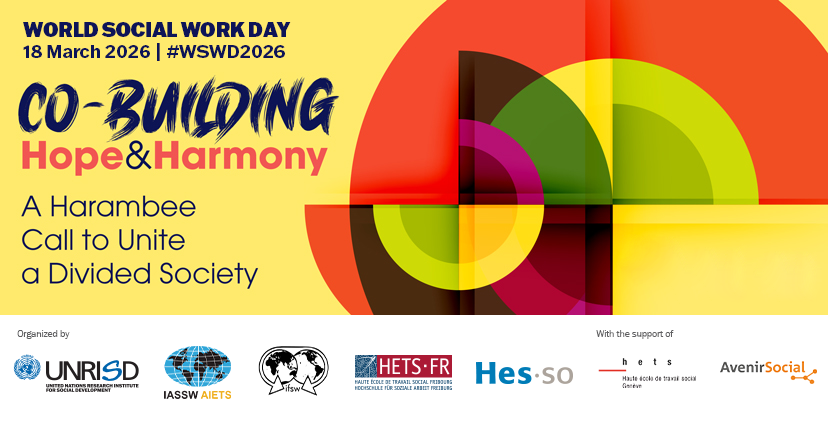
World Social Work Day (WSWD) at the United Nations in Geneva will be celebrated on 18 March 2026. The theme for this year, Co-Building Hope and Harmony: A Harambee Call to Unite a Divided Society, highlights the vital role of social work in bringing people together across communities, cultures and systems to shape a more inclusive and sustainable world. It underscores the central role of social work in rebuilding trust within and between communities. It is also an aspiration of new eco-social contracts, societal agreements that aim to rebuild broken relationships between states and citizens, between capital and labour, between the global North and the global South, and between humans and the natural environment. Inspired by the African philosophy of harambee—“pulling together” or “all for one”—the theme highlights how social work approaches and skills are essential for healing divisions, overcoming challenges, and fostering inclusive, cohesive societies.
Co-building hope and overcoming divisions in societies is also at the heart of the 2030 Agenda for Sustainable Development and reflected in the Doha Political Declaration that was adopted by UN member states at the second World Summit for Social Development that took place in Qatar in November 2025. Against this backdrop, WSWD 2026 aims to explore three issues:
1. How can we foster social cohesion in marginalized communities?
Marginalized groups often face structural barriers, historical injustices and community-level trauma that erode trust and weaken social bonds. Social work supports the rebuilding of trust by creating participatory spaces where people can voice their needs, recognize shared strengths, and shape collective goals. By facilitating dialogue and mediating emerging tensions, social workers help restore confidence between community members and local institutions and address underlying or historical injustices. Empowerment-based practices reinforce people’s sense of agency, while culturally sensitive facilitation ensures that those whose voices are often overlooked are included in decision-making processes. Through these trust-building efforts, social work strengthens the foundations of social cohesion at the community level.
Each year, social workers from around the world come together to celebrate World Social Work Day.
This year's edition, which will take place exclusively online, will highlight the vital role of social work in bringing people together across communities, cultures, and systems to shape a more inclusive and sustainable tomorrow.
The event is open to officials from international organizations, social work students and professionals, as well as anyone interested in innovative approaches to creating a more peaceful future.
Wednesday 18 March 2026
9:00–17:00
WORLD SOCIAL WORK DAY 2026
Organised by:
UNRISD
IASSW – AIETS
IFSW
HETS Fribourg
With the support of:
AvenirSocial
HETS-GE
online only / in English only
2. How can we overcome conflict, polarization and exclusion?
In contexts marked by polarization and conflict, effective interventions, policies and institutions that address the root causes and drivers of inequalities, conflict and social exclusion are crucial. At the community level, social workers act as mediators and bridge builders, enabling dialogue across groups with divergent experiences and interests. Their expertise in creating conditions of equity for free expression can pave the way for reconciliation and renewed relationships. By challenging exclusionary narratives and promoting equitable participation, social work actively contributes to societies in which dialogue, respect and non-discrimination is valued.
3. How can social work contribute to building resilient communities?
Resilience emerges when communities can collectively navigate adversity, mobilize internal strengths and build and access support systems and public goods. Social workers play a vital role by identifying local assets within communities and their environment, nurturing collaborative networks, and co-building buffers in forms of solidarity mechanisms against social and economic shocks. However, in times of long-term crises and multiple shocks, community resilience tends to be overstretched. Social workers can advocate for marginalized communities and create bridges with public services and government programmes for support. Through advocacy, co-creation of services, and community-driven planning, social workers contribute to fostering a sense of shared responsibility while strengthening awareness on people’s individual and collective rights and the need for accountable governments.
4. How can social workers and UN organizations work together for inclusive, resilient and peaceful societies?
Building on shared values and common agendas such as the UN Charter, the SDGs and the Doha Political Declaration, social workers, their representative organizations and schools of social work are collaborating with various UN agencies and international partners at national and global levels. In times of crisis, conflict and social polarization, this collaboration can support the diffusion of community-driven solutions and establish a channel of communication with policy makers, public administrations and service providers.
Programme
9:00–17:00
Opening remarks
- Magdalena Sepúlveda, Director, United Nations Research Institute for Social Development (UNRISD)
- Tatiana Valovaya, Director, United Nations Office at Geneva (UNOG) (TBC)
- Joël Gapany, Director, School of Social Work, HETS Fribourg
- Joachim Mumba, President, IFSW
- Chair: Sandrine Haymoz, School of Social Work, HETS Fribourg
Keynote presentation: Social work and global conflict: An integrated framework for practice
Prof. Heather Boetto, Charles Sturt University, Australia
Keynote presentation: Social work’s role in co-building resilient communities: A harambee path
Prof. Janestic M. Twikirize, Makerere University, Uganda
Roundtable: Overcoming divisions, re-building trust and strengthen resilience—what can be done?
- Talaat Hassan Hamoud, IFSW, Jemen
- Burçu Eke-Schneider, community peace worker, Berlin, GRAN-ESC
- Terrel Abeysinghe, Peace Worker, Fribourg
- Abigail Erikson, Executive Director of UN Women Bonn
- Chair: Katja Hujo, UNRISD
Reflections and Closing Remarks
Programme subject to change
Vous avez des questions? Contactez-nous!